- Physical difficulty: Easy
- Length: up to 30 min
- Wheelchair accessibility: Yes
Shakh’s synagogue
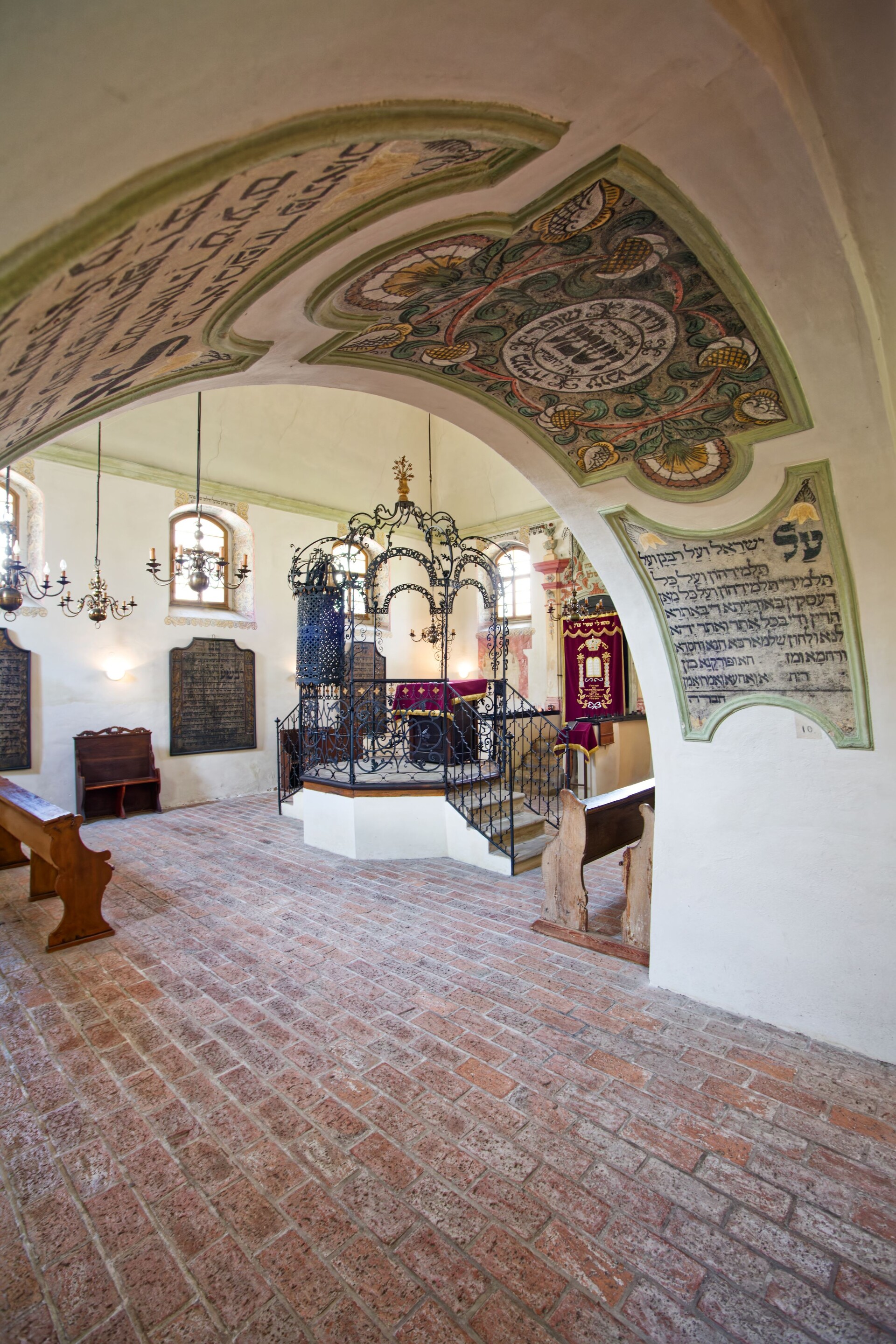
Shakh’s synagogue was built in 1560 and is now the fourth oldest synagogue in the Czech Republic. At the same time it is the second oldest one that still retains its original character. The current interior comes from the 1730’s when the synagogue underwent through a major reconstruction. During the reconstruction the still present Polish-type baroque decorations were created – such ornaments are present in just a few other synagogues in the world.
In 1893 the local Jews built a new reformed synagogue that had become the main synagogue in the community. Until the 1920’s, the “old one” was used only by the senior members of the community for the traditional orthodox services. After that it was used mainly as storage and the first floor was a flat until 1955. Thanks to this form of usage there was no need to damage the synagogue during World War II.
In the following years of the socialist era, when most of the other synagogues served all sorts of purposes, mostly as granaries or storage areas, the synagogue in Holešov was the only one that was reconstructed and in 1964 it was opened to the public with an exhibition tiled Jews in Moravia. The first floor of the synagogue, which originally served as a Talmudic study, now serves as a study again after a partial reconstruction carried out in 2016. Jewish visitors can study Shakh’s book directly in the place where he worked and lived. The study includes a small exhibition on rabbi Shakh. It has a beautifully decorated 18th century timber ceiling with the so-called Polish ornaments.
The synagogue is currently the property of the Jewish Community of Brno, and it is managed by the Municipal Cultural Centre of Holešov. Although there is no living Jewish community in Holešov, and despite the fact that the synagogue is mainly used as a heritage object, it is not just a mere museum. Thanks to the connection of the place with rabbi Shakh, Holešov is an important spiritual destination.
Many Jewish tourists visit the place every year, coming mainly from Israel and the USA to visit rabbi Shakh’s grave and pray in his synagogue where the rabbi prayed as well. In this way the synagogue still fulfils its original purpose. The synagogue is open to the public with guided tours and an annual Festival of Jewish Culture.